The Sketchbook as a Place for Decisions
Learn how artists used sketchbooks to study, gather motifs, and test ideas, then read unfinished pages as records of choices rather than failed art.
The common mistake when opening an old sketchbook is to judge every page as a small, unfinished picture. That costs you the chance to see what the marks preserve: choices made while an idea was still uncertain. In a sketchbook, repeated outlines, notes, and changes of medium can show how an artist studied a form or kept a possibility available for later work.
Start with visible evidence
Before asking what a sketch depicts, notice how the page is used. A few faint lines may test a pose; a dark patch may compare tones; a written note might record a color to use later. A drawing that stops abruptly may have done exactly what its maker needed.
Look for repeated outlines, corrections, arrows, small color trials, changes in pressure, or a second idea placed beside the first. Describe these features before explaining them. “Several outlines overlap” is visible evidence; “the artist could not decide” is an interpretation that the lines alone cannot confirm.
Workshop practice
Renaissance workshop drawings offer a concrete way to understand sketchbooks as places for learning and decision-making. In the Italian Renaissance, apprentices and assistants learned through copying and repeated drawing, while masters and workshop members used studies to develop figures and compositions. A notebook associated with Leonardo da Vinci, for instance, brings together observations, diagrams, written notes, and studies of subjects ranging from anatomy to mechanics. It does not read like a sequence of finished pictures; its pages record different kinds of inquiry.
That context matters when you see the same form drawn more than once. Repetition may be practice, comparison, or an attempt to understand how a body or object is built. It need not mean that the maker was dissatisfied with every version. Compare the changes on the page, but avoid turning them into a story of progress unless other evidence supports that reading.
Travel and collected motifs
In the eighteenth and nineteenth centuries, artists used portable sketchbooks to record landscapes, buildings, people, and details encountered away from the studio. J. M. W. Turner’s sketchbooks, including books made during his travels in Britain and Europe, preserve rapid landscape observations and notes. Their loose marks are useful to consider alongside his larger paintings: a travel sketch could gather visual material without being a miniature version of a finished work.
Travel pages also show why sequence needs care. A run of related views may follow a journey, but a page’s position alone cannot prove when or where it was made. A written place name, a recognizable landmark, or a connection to a dated work can strengthen an interpretation. Without such clues, describe what is present and keep the proposed setting tentative.
How to read a sketchbook page?
What do repeated lines tell you?
They show that a form was drawn more than once, perhaps to compare angles, proportions, or movement. To distinguish practice from revision, look for what changes between attempts and note when the page does not provide enough evidence to decide.
Does an unfinished page mean the artist gave up?
Not necessarily. A quick study or color trial may have served its purpose without becoming a complete image. “Unfinished” describes how a page looks; it does not establish why the maker stopped.
Can page order establish a timeline?
It can suggest a connection when subjects or techniques continue across neighboring pages. But removed leaves, blank pages, and later handling can complicate sequence, so look for dates, notes, or other supporting clues before assigning a firm chronology.
Why do museums display sketchbooks?
A display can let visitors examine the artist’s marks and the book’s paper, binding, and arrangement. Museums may show selected openings rather than the entire volume, so the exhibition view is not necessarily the same as encountering the sketchbook in ordinary use.
Separate object from intention
A sketchbook has a working life and a physical history. In use, it can be a convenient place for imperfect trials. Later, its paper, binding, stains, and edits affect what survives and how it is presented. These material traces are evidence of the object’s condition, but they do not automatically reveal the artist’s intention.
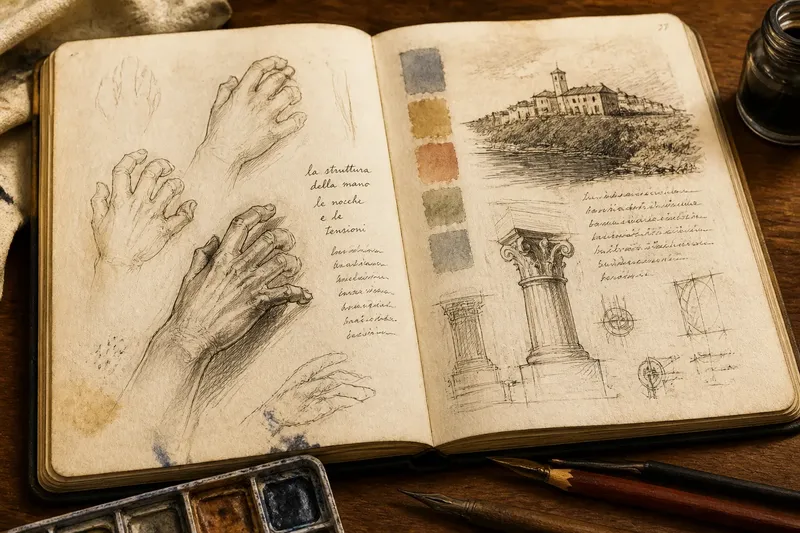
Imagine a bound notebook with repeated hand studies on one page and a short note beside them. The first outlines are light, while later ones emphasize the knuckles. You can describe that change and reasonably suggest the maker was studying the hand’s structure. If the note gives no date or audience, you cannot tell from the page alone whether it was written for a student, for the artist’s own use, or for another purpose. The responsible reading preserves that distinction.
Make a grounded reading
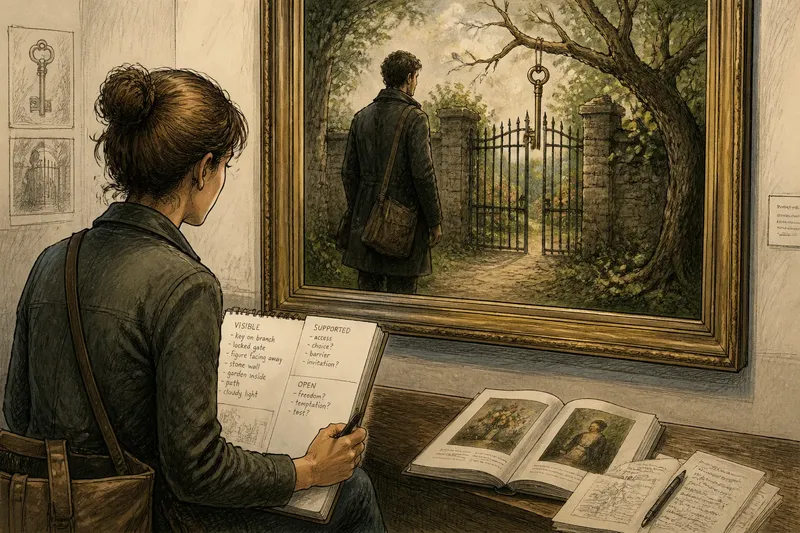
When you encounter a sketchbook in a gallery, give the page time before searching for a polished image. Notice the scale of the marks, how one thought sits beside another, and whether the display lets you see a sequence or only selected openings. A label may add context; the page still deserves a close look of its own.
- If repeated outlines change angle, compare the versions and decide whether the page supports a claim about studying form; if not, describe the repetition without assigning a motive.
- If a note names a place, check whether a visible landmark or another page supports the connection; if it does, treat the setting as better grounded, and if not, keep it tentative.
- If a page has a date, compare it with nearby dates before using it to order the sequence; if dates conflict or are absent, avoid presenting a firm timeline.
- If neighboring pages share a subject, describe the continuity and check for a change in medium or purpose; if the connection is unclear, treat each page separately.
- If a stain or tear is visible, record its location and distinguish it from drawn marks; if its cause is unknown, do not attribute it to the artist’s intention.
- If a museum shows only selected openings, look for label or display information about the selection; if none is provided, do not assume the displayed pages represent the whole book.
If you handle a sketchbook in a collection, follow staff directions and use the supports provided. Fragile bindings and loose media need careful treatment, and conservation staff can explain how a particular object should be viewed. At home, a plain notebook can preserve your own working choices without requiring every page to look presentable; a date or brief note about the problem you were testing can make the record easier to understand later.
The history of the sketchbook is not one simple shift from private tool to public artwork. Renaissance workshop studies, Turner’s travel observations, and later exhibition practices show distinct uses: learning, gathering motifs, testing possibilities, and presenting a working record. When a page seems unfinished, first ask what it visibly records; then let the available evidence set the limits of your interpretation.