Where Does Your Eye Land First in a Painting?
Where does your eye land first in a painting? Compare quick, slow, and guided looking to see what draws attention and choose a useful way to look.
The common mistake in looking at a painting is to assume the most noticeable feature must be the first thing that caught your eye. That shortcut can flatten the experience: a bright sleeve, dark doorway, or sharply outlined hand gets named, while the quieter path that led you there goes unnoticed. To ask where your eye lands first in a painting, try following the actual sequence of attention rather than naming the most dramatic object.
There is no need to settle on one “correct” answer. A painting can offer several routes, and your own position, mood, and viewing distance can change which one you take. Compare three approaches: a quick first glance, a slower scan, and a guided trace of visual direction. Each reveals something different, and each suits a different kind of visit.
Start With the First Glance
A quick glance is the least fussy way to begin. Stand at a comfortable distance, look at the whole painting for a moment, then look away and name the first area you remember. Keep the answer plain: “the pale face near the center,” not “the lonely figure.” The first describes a visible feature; the second already interprets it.
This approach suits a crowded gallery, a busy day, or anyone who wants to notice an immediate reaction without turning the visit into a formal exercise. It also gives you a useful baseline. If the painting’s brightest patch is a red cloth in the lower corner but you remember a small, dark window first, that difference is worth investigating.
Attention is not identical to brightness. A face can pull the eye because we recognize faces quickly. A crisp edge may stand out against a blurred area; a small isolated shape may attract notice because little else surrounds it. Position matters too: a feature near the middle can feel prominent, but an edge, a diagonal, or a gap in the composition can make an off-center detail difficult to ignore.
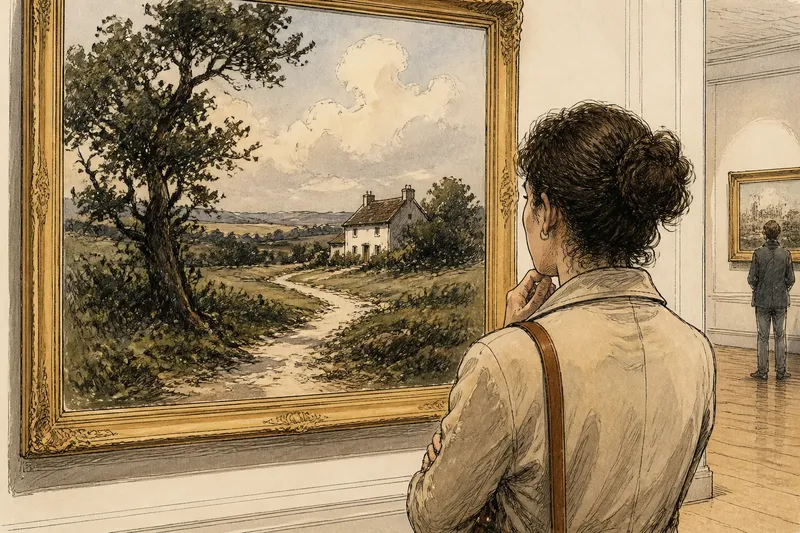
Say you look at an invented landscape with a pale sky, a dark tree at the left, and a narrow footpath winding toward a house. You glance once and remember the tree. On a second look, you notice the path because its light strip cuts through the darker ground. The observable result is not that one answer defeats the other: your first glance named the strongest immediate pull, while the second showed a route into the scene.
Compare Three Approaches
The quick glance, slow scan, and guided trace are not competing tests. Think of them as different ways of asking what visual evidence is doing. Choose by the kind of answer you want, not by trying to produce a definitive ranking.
- Quick glance: Notice the first feature you remember after looking briefly. Choose this when you want a low-effort starting point or are moving through a busy room.
- Slow scan: Let your gaze travel across the painting, pausing at changes in color, value, detail, and spacing. Choose this when the composition feels layered or the first impression seems too simple.
- Guided trace: Follow an apparent line of movement, such as a bent arm, a row of windows, or a streak of light, and see where it leads. Choose this when you want to understand how one area directs attention toward another.
A slow scan is not merely a longer first glance. It helps you compare what competes for attention. Look for a sharp edge beside a soft one, a saturated color among muted ones, or a cluster of small marks near a broad, quiet field. These contrasts can make one area feel active and another feel like a pause.
A guided trace starts with direction rather than prominence. Follow a gaze, a gesture, a road, a repeated shape, or an implied diagonal. The line may lead to a focal area, loop back, or stop at an unexpected edge. If you lose the route, that is useful information too: the direction may be weak, interrupted, or more ambiguous than it first appeared.
Trace the Visual Route
Once you have a first impression, ask what led you to it. Begin with the feature you noticed, then identify the contrast around it. Is it lighter than its surroundings? More sharply defined? More colorful? Does it sit alone, or is it part of a dense cluster?
Next, look for directional cues. A figure’s turned head may point toward a small object. A table edge may angle toward a hand. Repeated windows may carry your gaze across a building, while a curved branch may bring it back toward the center. These cues are not always literal lines; they can be alignments, gestures, or changes in spacing.
Then check placement. A detail near the center may act as an anchor, while a feature close to an edge can create tension or make the viewer scan back across the canvas. A focal area can also be a gap: a patch of open sky between dense shapes may catch attention because it gives the eye room to rest.
Keep the observation separate from the interpretation. “The bright band leads toward the figure” is a claim you can check by looking again. “The painter wants me to feel hopeful” is a possible reading, but it needs more than a bright band to support it. Starting with visible relationships leaves room for meaning to emerge without forcing a story onto the painting.
When Should You Look Again?
Can a painting have more than one focal point?
Yes. Two areas may compete, or attention may move between them in a repeated loop. Notice whether color, scale, direction, or spacing connects the areas, then see if the route feels balanced or deliberately unsettled.
Does the brightest color always draw the eye first?
No. A face, a sharp outline, a strong light-dark contrast, or a solitary shape can outweigh a bright hue. Compare the bright area with the surrounding edges and forms before deciding what dominates.
How long should I spend looking?
Long enough to notice one feature you missed at first, then stop if your attention has gone stale. A brief return after looking at another work can reveal whether the same area still pulls you in.
What if I cannot identify a first point?
Describe the general movement instead: “my eye drifts from the upper left to the center,” or “I keep moving between the two figures.” A route can be more informative than a single starting spot, especially in a painting with loose or evenly distributed detail.
Choose by Your Question
Let your purpose decide which approach to use. If you have only a moment, the first-glance method gives you a clean starting point. If the painting seems confusing or crowded, a slow scan can separate its competing contrasts. If the composition feels as though it is moving somewhere, trace the directional cues and see where they lead.
You can also compare approaches without turning them into a rigid routine. Look once, name what you noticed, then return with one specific question: “What makes that area stand out?” or “Where does this diagonal take me?” A question keeps the second look focused while allowing the painting to complicate your first answer.
Imagine an invented still life with a white cup, a folded blue cloth, and a narrow shadow crossing the table. You first notice the cup because it is light against the darker objects. Choose a slow scan and you may notice that the cloth’s diagonal points back toward the cup; choose a guided trace and you may follow the shadow away from it. The expected observable result is a clearer account of how separate visual features organize attention, not a single compulsory reading.
If you are looking with someone else, compare descriptions before comparing conclusions. One person might notice a face; another might notice the line of a shoulder leading toward it. Ask each other to point to the evidence in the painting. Different starting points often reveal that the composition allows several routes, rather than proving that one viewer looked more carefully.
Let the Painting Correct You
The most useful close-looking exercise ends with a return to the painting, not a verdict about it. After tracing contrast, placement, and direction, look once more at the whole surface. Does your first point still seem first, or has another feature taken over? That change may come from seeing a connection, not from making a mistake.
When you wonder where your eye lands first in a painting, treat your answer as an observation to check. A quick glance identifies an immediate pull, a slow scan reveals competing choices, and a guided trace makes the route more visible. Pick the one that matches your question, then let the painting’s actual edges, colors, and gestures support or revise what you thought you saw.