The Symbol-Hunting Trap in Art
The symbol-hunting trap in art turns visible objects into fixed answers. A context-first routine helps you separate what you see from what you can support.
The most common mistake in the symbol-hunting trap in art is deciding what an object means before looking at what surrounds it. A painted key becomes “freedom,” a dog becomes “loyalty,” and the picture shrinks to a code-breaking exercise that can miss its mood, structure, and uncertainty. Try a context-first routine across a week: it gives your interpretation room to develop without asking you to abandon symbolic clues.
Day one: name what’s visible
Choose one painting in a museum, gallery, book, or collection website. Write down what you can point to without interpretation: “a brass-colored key rests beside a bowl,” not “a key represents escape.” Include placement, scale, color, condition, and what appears near each object. A notes app or pocket notebook works; leave space between observations for ideas you have later.
This first pass is not an effort to become neutral. It is a way to notice when a description quietly turns into a claim. “The room is oppressive” interprets; “the figure sits beneath a low, dark ceiling” gives someone else something visible to check. Keep both kinds of notes, but mark them differently.
Day two: map the setting
Look beyond the object that first caught your attention. Ask what kind of scene the work presents: a domestic interior, a public ceremony, a landscape, a staged arrangement, or something less easily named. Notice who is present, where the action seems to happen, and whether the objects appear to belong together.
Composition can change a clue’s force. A flower placed among other flowers may function differently from one isolated in a bare room. A crown worn by a figure, held by another person, or left on the floor is not the same visual event. Describe those relationships before assigning meanings.
Day three: test the object
Choose one object and list several possible roles. It might be practical, decorative, part of a familiar convention, a marker of status, or simply a shape the artist needed in that area. These possibilities can overlap. The point is not to produce an endless list but to resist treating the first association as settled fact.
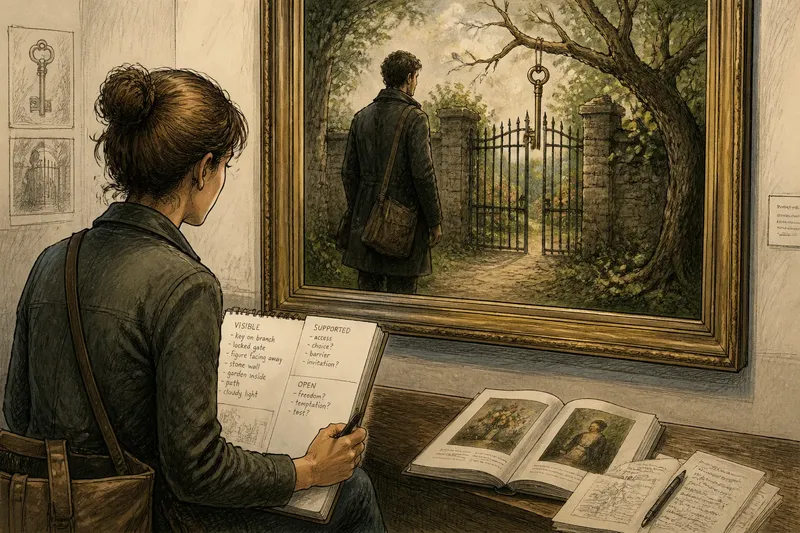
Say you are looking at an invented painting of a traveler beside a locked gate, with a key hanging from a nearby branch. You first read the key as a promise of escape. On a closer look, the traveler faces away from it and the gate appears to enclose a garden rather than a road; you might keep “escape” as one possibility while noting that the key’s placement also creates a visual link between the figure and the barrier. The observable result is a more precise description, not a final answer.
Day four: seek context carefully
Check the wall label or collection entry for the work’s title, maker, medium, and any stated subject. If the institution offers a short interpretive note, treat it as a useful source of context, not a command to see the painting one way. Titles can direct attention, but they can also be broad, poetic, or supplied long after a work was made.
When available, look for information about the setting in which the work was made or first encountered. A religious image, portrait, political scene, and still life may draw on different conventions. Use reliable museum material or a catalog when you need that background; if the information is absent, record the gap instead of filling it with a confident-sounding guess.
Day five: compare nearby clues
Return to your notes and ask whether the object’s meaning fits the rest of the scene. Do other details reinforce your reading, complicate it, or point elsewhere? A repeated motif may matter because of its recurrence, while a single object may be incidental. Color, gesture, gaze, and spatial arrangement can support an interpretation without acting like a dictionary.
Separate your notes into three plain categories:
- Visible: details you can locate in the image.
- Supported: interpretations backed by several visual relationships or relevant context.
- Open: possibilities that remain plausible but uncertain.
This small sorting habit helps keep uncertainty useful. “The key may suggest access, though no one reaches for it” is more informative than either “the key means access” or “objects have no meaning.”
Day six: compare another work
Find a second work that includes a similar object, preferably from a different setting or genre. Compare how the object is used and positioned rather than assuming that its presence carries the same message. A sword in a formal portrait, a stage scene, and a still life can prompt different readings because the surrounding people, actions, and conventions differ.
If you do not have another work at hand, compare two appearances of the object within the same image, if there are any. Ask what changes when the object is handled, hidden, repeated, or left unused. This is a comparison of visual circumstances, not a hunt for a universal symbol chart.
Day seven: write a flexible reading
Use your notes to make a short interpretation with three parts: what you observe, what those details might suggest, and what remains unclear. For instance: “The key hangs near the gate, but the figure does not reach for it. It may suggest access or a choice left unused; the image does not tell me whether the figure can take it.” That account makes a claim while showing its limits.
Keep the wording open to revision. If new context changes your view, update the interpretation rather than defending your first hunch. Art can sustain more than one reading, but not every reading is equally grounded: the strongest ones explain visible details and acknowledge what they cannot settle.
Questions about symbols?
Does an object always have a symbolic meaning?
No. An object may serve a practical, compositional, decorative, or symbolic role, and those roles can coexist. Its meaning depends on the image and the context available.
How can I tell a clue from a guess?
A clue is something visible or supported by relevant context; a guess is a possible explanation that lacks enough support so far. Labeling an idea as tentative lets you explore it without presenting it as established.
Should I look up a symbol guide?
A reference can introduce conventions worth checking, but it cannot settle what an object means in every image. Compare its information with the work’s setting, composition, and other details.
What if two readings both fit?
Keep both if each accounts for visible evidence, and explain where they differ. The symbol-hunting trap in art is not noticing possible meanings; it is mistaking one plausible meaning for a fixed answer.
When you leave a work, carry one unresolved question rather than a complete code: why is that object placed there, and what changes if you read it another way? That question keeps your attention attached to the image, where new details can still alter the answer.